

13 KiB
Config-Driven Architecture
The KOGRAL follows a config-driven architecture where all behavior is defined through Nickel configuration files rather than hardcoded in Rust.
Philosophy
"Configuration, not code, defines behavior"
Instead of hardcoding storage backends, embedding providers, or query parameters, KOGRAL uses a layered configuration system that composes settings from multiple sources:
- Schema contracts (type definitions)
- Defaults (base values)
- Mode overlays (dev/prod/test optimizations)
- User customizations (project-specific overrides)
This approach provides:
- ✅ Type safety - Nickel contracts validate configuration before runtime
- ✅ Composability - Mix and match configurations for different environments
- ✅ Discoverability - Self-documenting schemas with inline documentation
- ✅ Hot-reload - Change behavior without recompiling Rust code
- ✅ Double validation - Nickel contracts + serde ensure correctness
Configuration Composition Flow
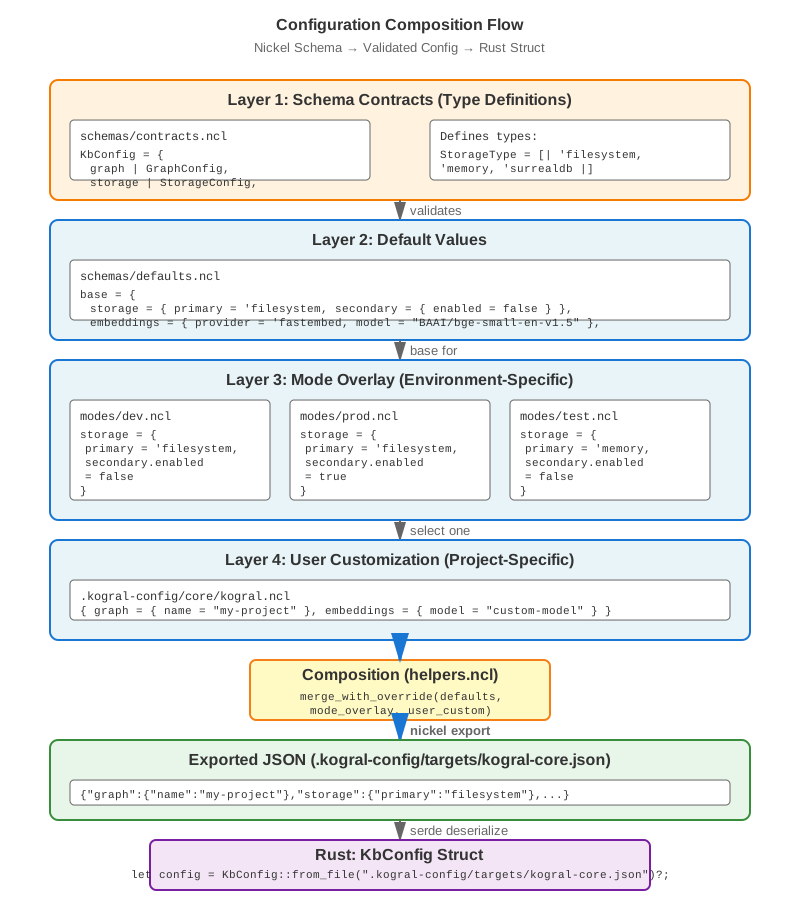
The configuration system uses a four-layer composition pattern:
Layer 1: Schema Contracts
Location: schemas/contracts.ncl
Purpose: Define types and validation rules using Nickel contracts.
Example:
{
  StorageType = [| 'filesystem, 'memory, 'surrealdb |],

  StorageConfig = {
    primary | StorageType
      | doc "Primary storage backend"
      | default = 'filesystem,

    secondary | SecondaryStorageConfig
      | doc "Optional secondary storage"
      | default = { enabled = false },
  },
}
Benefits:
- Enum validation (only valid storage types accepted)
- Required vs optional fields
- Default values for optional fields
- Documentation attached to types
Layer 2: Defaults
Location: schemas/defaults.ncl
Purpose: Provide sensible base values for all configuration options.
Example:
{
  base = {
    storage = {
      primary = 'filesystem,
      secondary = {
        enabled = false,
        type = 'surrealdb,
        url = "ws://localhost:8000",
      },
    },
    embeddings = {
      enabled = true,
      provider = 'fastembed,
      model = "BAAI/bge-small-en-v1.5",
      dimensions = 384,
    },
  } | contracts.KbConfig,
}
Validated by: contracts.KbConfig contract ensures defaults are valid.
Layer 3: Mode Overlays
Location: schemas/modes/{dev,prod,test}.ncl
Purpose: Environment-specific optimizations and tuning.
Development Mode (dev.ncl)
Optimized for: Fast iteration, local development, debugging
{
  storage = {
    primary = 'filesystem,
    secondary = { enabled = false },  # No database overhead
  },
  embeddings = {
    provider = 'fastembed,  # Local, no API costs
  },
  sync = {
    auto_index = false,  # Manual control
  },
}
Production Mode (prod.ncl)
Optimized for: Performance, reliability, scalability
{
  storage = {
    secondary = { enabled = true },  # SurrealDB for scale
  },
  embeddings = {
    provider = 'openai,  # High-quality cloud embeddings
    model = "text-embedding-3-small",
    dimensions = 1536,
  },
  sync = {
    auto_index = true,
    debounce_ms = 300,  # Fast response
  },
}
Test Mode (test.ncl)
Optimized for: Fast tests, isolation, determinism
{
  storage = {
    primary = 'memory,  # Ephemeral, no disk I/O
  },
  embeddings = {
    enabled = false,  # Disable for speed
  },
  sync = {
    auto_index = false,
    debounce_ms = 0,  # No delays in tests
  },
}
Layer 4: User Customizations
Location: .kogral-config/core/kogral.ncl or .kogral-config/platform/{dev,prod,test}.ncl
Purpose: Project-specific or deployment-specific overrides.
Example (user project config):
let mode = import "../../schemas/modes/dev.ncl" in

let user_custom = {
  graph = {
    name = "my-project",
  },
  embeddings = {
    provider = 'claude,  # Override to use Claude
    model = "claude-3-haiku-20240307",
  },
  query = {
    similarity_threshold = 0.7,  # Stricter threshold
  },
} in

helpers.compose_config defaults.base mode user_custom
  | contracts.KbConfig
Composition Mechanism
The helpers.ncl module provides the composition function:
{
  # Recursively merge with override precedence
  merge_with_override = fun base override => /* ... */,

  # Compose three layers
  compose_config = fun defaults mode_config user_custom =>
    let with_mode = merge_with_override defaults mode_config in
    merge_with_override with_mode user_custom,
}
Merge behavior:
- Records are merged recursively
- Override values take precedence over base values
- Arrays are not merged, override replaces base
- Null in override keeps base value
Example merge:
base = { storage = { primary = 'filesystem }, embeddings = { enabled = true } }
override = { storage = { primary = 'memory } }
# Result: { storage = { primary = 'memory }, embeddings = { enabled = true } }
Export to JSON
Once composed, the Nickel configuration is exported to JSON for Rust consumption:
nickel export --format json .kogral-config/core/kogral.ncl > .kogral-config/targets/kogral-core.json
Output (.kogral-config/targets/kogral-core.json):
{
  "graph": {
    "name": "my-project",
    "version": "1.0.0"
  },
  "storage": {
    "primary": "memory",
    "secondary": {
      "enabled": false
    }
  },
  "embeddings": {
    "enabled": true,
    "provider": "claude",
    "model": "claude-3-haiku-20240307",
    "dimensions": 768
  }
}
Rust Integration
The Rust code deserializes the JSON into typed structs using serde:
use serde::{Deserialize, Serialize};

#[derive(Debug, Deserialize, Serialize)]
pub struct KbConfig {
    pub graph: GraphConfig,
    pub storage: StorageConfig,
    pub embeddings: EmbeddingConfig,
    pub templates: TemplateConfig,
    pub query: QueryConfig,
    pub mcp: McpConfig,
    pub sync: SyncConfig,
}

impl KbConfig {
    pub fn from_file(path: &Path) -> Result<Self> {
        let json = std::fs::read_to_string(path)?;
        let config: KbConfig = serde_json::from_str(&json)?;
        Ok(config)
    }
}
Usage in kogral-core:
let config = KbConfig::from_file(".kogral-config/targets/kogral-core.json")?;

// Config drives behavior
let storage: Box<dyn Storage> = match config.storage.primary {
    StorageType::Filesystem => Box::new(FilesystemStorage::new(&config)?),
    StorageType::Memory => Box::new(MemoryStorage::new()),
    StorageType::SurrealDb => Box::new(SurrealDbStorage::new(&config).await?),
};

let embeddings: Box<dyn EmbeddingProvider> = match config.embeddings.provider {
    EmbeddingProviderType::FastEmbed => Box::new(FastEmbedProvider::new()?),
    EmbeddingProviderType::OpenAI => Box::new(RigEmbeddingProvider::openai(&config)?),
    EmbeddingProviderType::Claude => Box::new(RigEmbeddingProvider::claude(&config)?),
    EmbeddingProviderType::Ollama => Box::new(RigEmbeddingProvider::ollama(&config)?),
};
Double Validation
Configuration is validated twice:
1. Nickel Contract Validation
At export time, Nickel validates:
- ✅ Types match contracts (e.g.,
primary | StorageType) - ✅ Required fields are present
- ✅ Enums have valid values
- ✅ Nested structure is correct
Error example:
error: contract broken by a value
  ┌─ .kogral-config/core/kogral.ncl:15:5
  │
15│     primary = 'invalid,
  │     ^^^^^^^^^^^^^^^^^^^ applied to this expression
  │
  = This value is not in the enum ['filesystem, 'memory, 'surrealdb]
2. Serde Deserialization Validation
At runtime, serde validates:
- ✅ JSON structure matches Rust types
- ✅ Field names match (with rename support)
- ✅ Values can be converted to Rust types
- ✅ Required fields are not null
Error example:
Error: missing field `graph` at line 1 column 123
Benefits of Config-Driven Architecture
1. Zero Hardcoding
Bad (hardcoded):
// Hardcoded - requires recompilation to change
let storage = FilesystemStorage::new("/fixed/path");
let threshold = 0.6;
Good (config-driven):
// Config-driven - change via .ncl file
let storage = create_storage(&config)?;
let threshold = config.query.similarity_threshold;
2. Environment Flexibility
Same codebase, different behavior:
# Development
nickel export .kogral-config/platform/dev.ncl > targets/kogral-core.json
# → Filesystem storage, fastembed, no auto-sync

# Production
nickel export .kogral-config/platform/prod.ncl > targets/kogral-core.json
# → SurrealDB enabled, OpenAI embeddings, auto-sync

# Testing
nickel export .kogral-config/platform/test.ncl > targets/kogral-core.json
# → In-memory storage, no embeddings, isolated
3. Self-Documenting
Nickel contracts include inline documentation:
StorageType = [| 'filesystem, 'memory, 'surrealdb |]
  | doc "Storage backend type: filesystem (git-tracked), memory (ephemeral), surrealdb (scalable)",
IDEs can show this documentation when editing .ncl files.
4. Type-Safe Evolution
When adding new features:
- Update contract in
contracts.ncl - Add default in
defaults.ncl - Export validates existing configs
- Rust compilation validates deserialization
Breaking changes are caught before runtime.
5. Testability
Different test scenarios without code changes:
# test-semantic-search.ncl
let test_config = defaults.base & {
  embeddings = { enabled = true, provider = 'fastembed },
  query = { similarity_threshold = 0.3 },
} in test_config
#[test]
fn test_semantic_search() {
    let config = KbConfig::from_file("test-semantic-search.json")?;
    // Config drives test behavior
}
Configuration Discovery
KOGRAL tools automatically discover configuration:
- Check
.kogral-config/targets/kogral-core.json(pre-exported) - Check
.kogral-config/core/kogral.ncl(export on-demand) - Check environment variable
KOGRAL_CONFIG - Fall back to embedded defaults
impl KbConfig {
    pub fn discover() -> Result<Self> {
        if let Ok(config) = Self::from_file(".kogral-config/targets/kogral-core.json") {
            return Ok(config);
        }

        if Path::new(".kogral-config/core/kogral.ncl").exists() {
            // Export and load
            let output = Command::new("nickel")
                .args(["export", "--format", "json", ".kogral-config/core/kogral.ncl"])
                .output()?;
            return serde_json::from_slice(&output.stdout)?;
        }

        if let Ok(path) = std::env::var("KOGRAL_CONFIG") {
            return Self::from_file(&path);
        }

        Ok(Self::default())  // Embedded defaults
    }
}
Integration with justfile
The justfile integrates configuration validation:
# Validate all Nickel configs
nickel-validate-all:
    @echo "Validating Nickel schemas..."
    nickel typecheck schemas/contracts.ncl
    nickel typecheck schemas/defaults.ncl
    nickel typecheck schemas/helpers.ncl
    nickel typecheck schemas/modes/dev.ncl
    nickel typecheck schemas/modes/prod.ncl
    nickel typecheck schemas/modes/test.ncl
    nickel typecheck .kogral-config/core/kogral.ncl

# Export all platform configs
nickel-export-all:
    @echo "Exporting platform configs to JSON..."
    @mkdir -p .kogral-config/targets
    nickel export --format json .kogral-config/platform/dev.ncl > .kogral-config/targets/kogral-dev.json
    nickel export --format json .kogral-config/platform/prod.ncl > .kogral-config/targets/kogral-prod.json
    nickel export --format json .kogral-config/platform/test.ncl > .kogral-config/targets/kogral-test.json
    @echo "Exported 3 configurations to .kogral-config/targets/"
Usage:
just nickel::validate-all  # Check configs are valid
just nickel::export-all    # Generate JSON for all environments
Best Practices
1. Never Hardcode
If it's behavior, it's config:
- Storage paths
- API endpoints
- Thresholds
- Timeouts
- Feature flags
- Provider selection
2. Use Modes for Environment Differences
Don't put environment-specific values in user config:
Bad:
# user config with env-specific values
{
  storage = {
    url = if env == "prod" then "prod-url" else "dev-url"  # Don't do this
  }
}
Good:
# modes/prod.ncl
{ storage = { url = "prod-url" } }

# modes/dev.ncl
{ storage = { url = "dev-url" } }

# user config is environment-agnostic
{ graph = { name = "my-project" } }
3. Document Complex Fields
Use Nickel's doc metadata:
similarity_threshold | Number
  | doc "Minimum cosine similarity (0-1) for semantic search matches. Higher = stricter."
  | default = 0.6,
4. Validate Early
Run nickel typecheck in CI/CD before building Rust code.
5. Version Configs
Track .ncl files in git, ignore .kogral-config/targets/*.json (generated).
See Also
- Schema Reference: Configuration Schema
- User Guide: Configuration Guide
- ADR: Why Nickel vs TOML
- Examples:
.kogral-config/core/kogral.ncl,.kogral-config/platform/*.ncl